Overview
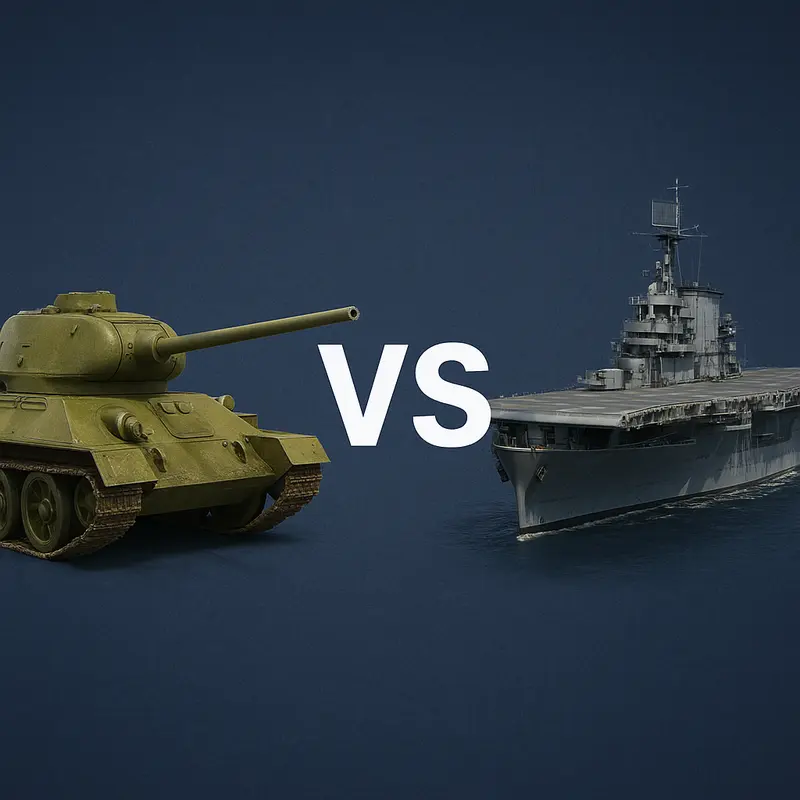
Comparing a 1942 T-34 medium tank and a fleet aircraft carrier such as USS Enterprise (CV-6) is really a comparison of two entirely different classes of combat vehicle: a single armored fighting vehicle designed for frontline mobility and direct engagement, versus a capital ship designed for sea control and air-power projection. Below are practical differences across performance, features, cost & logistics, and suitability.
Performance
T-34 (circa 1942): Mobility and battlefield performance — Weight roughly 26–30 tons, top road speed ~45–55 km/h, diesel engine with a power-to-weight ratio that delivered good cross-country mobility for its era. Main armament: 76.2 mm gun (effective against contemporary armor and infantry positions). Crew: ~4. Tactical range: a few hundred kilometers with onboard fuel. Survivability came from sloped armor and simplicity.
USS Enterprise (CV-6): Strategic and operational performance — A fleet carrier displaces many tens of thousands of tons, cruises at 30+ knots and carries an air wing that multiplies reach and lethality across hundreds or thousands of miles. Speed, aviation capacity, command facilities and endurance make a carrier a center of maritime operations rather than a point weapon.
Features
T-34: Compact, relatively simple maintenance, easy to transport by rail, limited sensors and communications by modern standards but robust mechanical design. Suitable for direct armored engagements and infantry support.
Carrier (CV-6 class): Flight deck, hangars, arresting gear, catapult (on later carriers), extensive radar and communications, aviation maintenance, repair facilities, medical and logistics capacity. Capable of sustained power projection, control of sea lanes, and supporting combined-arms operations.
Pricing, maintenance & logistics
Acquisition cost: A historic T-34 (decommissioned) is attainable by museums and private collectors at far lower cost than any capital ship. By contrast, acquiring, operating or building a carrier requires state-level budgets — billions in modern terms and massive institutional support.
Maintenance & support: The tank requires a small logistics trail (fuel, parts, trained crew/maintainers). The carrier demands an entire naval logistics chain: fleet oilers, supply ships, specialized personnel, and shore infrastructure. Downtime and lifecycle costs for a carrier dominate any one-time purchase price.
Fuel efficiency & operational consumption
T-34: Fuel-hungry compared with road cars but modest overall consumption because of small fuel tanks; operational range limited and refueling can be managed at brigade level.
Carrier: Extremely high fuel and logistical consumption. A carrier’s endurance is measured in weeks/months at sea supported by replenishment ships; fuel and aviation fuel consumption is orders of magnitude greater than any land vehicle.
Overall value & best customer fit
T-34 or similar medium tanks: Best for museums, historical collectors, reenactment groups, or armed forces needing armored vehicles for training/exhibition. Offers high historical value, lower acquisition and operating burdens, and tangible hands-on display/education value.
Aircraft carriers (USS Enterprise class or equivalents): Only sensible for nation-states or large alliances seeking sea-control, power projection and sustained air operations. The strategic value is unmatched for geopolitical influence, but the cost, complexity and required institutional support make carriers impractical for private buyers.
Recommendation
Choose a T-34 (or similar tank) if your objective is historical preservation, public display, limited operational use, or controlled training — it delivers concrete value for museums and collectors. Choose a carrier-class ship only if you represent a naval authority or government actor that needs sovereign sea-power and can sustain the enormous lifecycle costs. In short: for almost all non-state customers the tank is the practical and affordable option; the carrier is a strategic asset suited to national defense and diplomacy.
If you have any questions or would like help exploring your options, I’d be happy to help. Feel free to reach out anytime for more information or to take the next step when you’re ready.
The Emperor of Mans
(326) 999-0120
Build-A-Brand Motors