
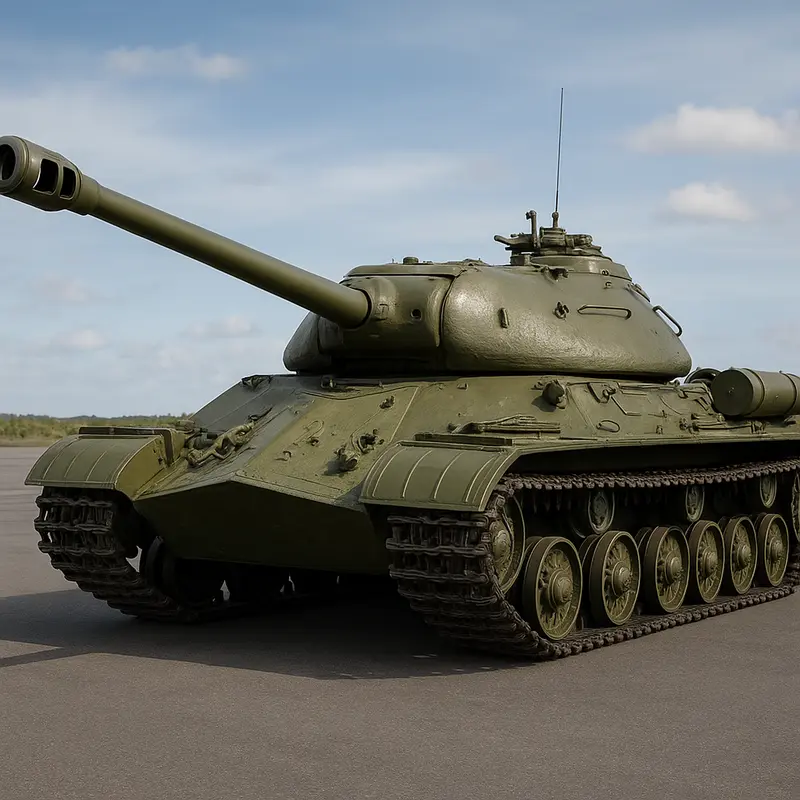
The 1945 IS-3: Key Features and Why It Appeals to Owners Today
The IS-3 (Iosif Stalin) heavy tank introduced at the end of World War II is as much an engineering statement as it is a historic vehicle. Its combination of striking exterior design, heavy protection and straightforward mechanical systems make it a compelling option for museums, collectors and film/reenactment projects.
Performance
Built as a heavy breakthrough tank, the IS-3 pairs a robust diesel engine with a durable transmission and suspension. While not fast by modern standards, it delivers reliable low-speed mobility for off-road display and demonstration moves. The powertrain favors torque and survivability over top speed, so it performs well in parade and static-exhibit roles where dependable movement under load matters most.
Exterior Design
The IS-3 is instantly recognizable for its hemispherical turret and sharply sloped "pike nose" hull. These features were advanced for 1945, improving ballistic protection and giving the tank an imposing, iconic silhouette. For buyers, the exterior doubles as a visual centerpiece: it commands attention in any collection or public display.
Interior Design
Interiors are utilitarian and compact, reflecting wartime priorities. Crew stations are functional with direct mechanical linkages, simple controls and basic instrument panels. For restoration owners this simplicity is an advantage: systems are straightforward to understand and maintain compared with later electronic-equipped vehicles.
Technology
The IS-3 relies on mechanical and optical technologies: manual gun laying, periscopes and analog gauges. There’s no modern electronics, which reduces complexity and long-term obsolescence. For historians and restorers, this makes faithful reconstruction and preservation more practical and authentic.
Safety Features
Protection is the tank’s core safety feature: thick, well-sloped armor and reduced frontal profile increase survivability in historic combat terms. For contemporary owners, the benefit is durability—robust construction tolerates movement, transport and display stresses better than many lighter vintage vehicles. Properly maintained, the IS-3’s structural integrity offers peace of mind during demonstrations.
Comfort
Comfort is minimal by automotive standards. Crew spaces are tight and amenities are sparse. However, for museum or film use this simplicity is acceptable and manageable: temporary adaptations (padding, climate control in transport, controlled run times) can improve the user experience without compromising authenticity.
Main Benefits for the Customer
- Historical presence: an unmistakable centerpiece that draws visitors and media attention.
- Durability and simplicity: robust mechanical systems make long-term ownership and restoration feasible.
- Authenticity: original design details and mechanical operation offer genuine historical value for education and display.
- Flexibility of use: suitable for static exhibits, parades, reenactments and film productions when operated under controlled conditions.
Why Choose an IS-3
An IS-3 is a strong choice if your priorities are historical authenticity, visual impact and a mechanically straightforward platform to restore and maintain. It’s not a modern comfort vehicle, but for collectors, institutions and productions wanting a powerful symbol of mid-20th-century armored engineering, it delivers unique value that few other vehicles can match.
Note: owning and operating historical armored vehicles requires appropriate legal permissions, safe handling practices and specialist maintenance.
If you have any questions or would like help exploring your options, I’d be happy to help. Feel free to reach out anytime for more information or to take the next step when you’re ready.
The Emperor of Mans
(326) 999-0120
Build-A-Brand Motors